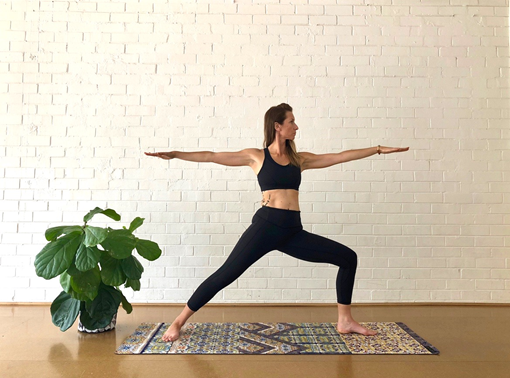
Warrior II
Warrior II (Virabhadrasana II)
Virabhadra: Warrior
Purpose
Warrior II is a great pose for strengthening the legs, opening the hips and creating power in the upper body. Virabhadra was a great warrior created by Shiva from a lock of his hair to lead his army to war in revenge of the death of his loved one.
Benefits
The open hip position in Warrior II develops great leg strength while encouraging the hips to open. Its powerful position challenges the legs, but creates a freedom in the hips and chest. Our core muscles are engaged, while arms reach wide, bringing vitality and tone to shoulders and upper body. Runners, rowers, horse riders all benefit from this great opportunity to open the body and find freedom.
Drishti
Eye level.
Key alignment points
Press soles of the feet into the earth
Position rear foot at an angle that takes pressure off the knee, 45-90 degrees
Both inner thighs rotate away from each other while the hips open
Front ankle, knee and hip on the one line
Arms in line with shoulders, laterally rotating so the biceps spin upwards
Scapula depressed
Chest facing to the side, not forward facing
Core muscles engaged
Mental focus
Powerful mental focus, drawing deep breaths into the lungs to fuel the pose.
Example dialogue
Coming from Warrior I “Inhale straighten the front leg, exhale, open your arms and hips to Warrior II. Press down through your feet, lifting both inner arches and plug your heels into the mat. Check your front knee is directly over your ankle to the baby toe side of the foot, and squeeze both thighs strong! Rotate your inner thighs towards the sky and sink your hips towards the earth. With your pelvis neutral – reach your spine up to the roof – take your arms wide and draw both scapula towards the midline of your back. Bandha in, breathe.”
Basic physical assists
Ground the rear foot and lift the inner arch
Check front knee over ankle, and staying correctly aligned towards the baby toe
Fist to the belly to encourage uddiyana bandha
Rotate inner thighs away from each other
Inspire arms to reach away from each other, drawing shoulders down the back
Common mistakes
Feet inactive, with arches of feet flat
Front knee caving in placing pressure through medial knee
Back knee bent
No movement from the rear hip towards the back – not opening
Belly switched off, compressing lower back region
Shoulders up around the ears
Back arm dropping
Modifications
Encourage shorter stance for more stability and to help with correct alignment
Hands to heart, or hips if any shoulder/neck conditions that are becoming aggravated, and to relax the shoulders